Showing posts with label film thoughts. Show all posts

Thursday, June 12, 2014

Go Home, Screenplay, You're Drunk: Pacific Rim

Following in the footsteps of my international sensation "Scenes I'll Never Write In Screenplays," I've decided to start a new segment here on The Fabulist, wherein I take the basic storytelling elements of movies I enjoy or admire (usually big blockbusters) and attempt to restructure or slim them down into more understandable, more digestible versions thereof.

I'm calling it "Go Home, Screenplay, You're Drunk" and, for my inaugural post, I'm starting with a very popular movie from 2013, especially among the "Timothy's girlfriend" demo. That's right, it's time to do some unasked-for script work on:

So, spoiler warning, obviously.
The film opens in Tokyo, 2016. We follow a 10-year-old Japanese girl as she runs frightened and crying through the streets, pursued by an enormous, building-destroying monster. As she does, we hear voice-over narration from an unknown voice (Charlie Hunnam), explaining the film's basic premise; massive monsters, known as kaiju, started appearing out of a portal in the Pacific Ocean, attacking coastal cities. We were defenseless against them.


As the little girl hides down an alley, suddenly a massive robot appears, which the V.O. describes as a Jaeger – a weapon designed by humanity to finally start battling the kaiju back. We watch a brief, exciting tussle between machine and monster, while the child cowers beneath a dumpster. Finally, when the monster is defeated, the girl emerges from hiding and is summarily rescued.

Title drop.

Flash forward to the Shatterdome, the headquarters of the underfunded Jaeger progam in Hong Kong. Mako Mori (Rinko Kikuchi), now an adult, works to repair on a decrepit old Jaeger by the name of Gipsy Danger. She's summoned by her superior, Stacker Pentecost (Idris Elba), to report for physical compatibility training. As she hustles to the training room, we see her cross the Shatterdome, revealing its three massive Jaegers. Along the way, she briefly banters with the crews of Crimson Typhoon and Cherno Alpha, the Chinese and Russian Jaegers, respectively, hoping today will be the day she finds a co-pilot for Gipsy Danger.

In the training room, Mako roundly defeats all her challengers in unarmed combat. Pentecost is not pleased, however, explaining that the purpose of the training isn't to best your opponent, but to anticipate their moves. He explains that piloting a Jaeger takes teamwork, requires a partner who's drift compatible and who shares some underlying experiences. Pentecost claims to have rounded up other survivors of that initial attack on Tokyo for her to train against, but none of them seem to be compatible with her. She's technically proficient, but very emotionally walled-off. This seems to give him an idea.

Pentecost is quickly accosted by a pair of scientists, Newton (Charlie Day) and Hermann (Burn Gorman), who present their competing theories about the kaiju's origin. Hermann explains the physics of the Rift and his theory that a properly placed bomb would succeed in severing the link between the dimensions. Newt's theory, however, is deemed substantially more dangerous – using the technology that allow Jaeger pilots to meld minds to drift with a kaiju. Pentecost dismisses this idea, tells Hermann to begin development on a bomb and flies off to Alaska to follow a hunch.

In Alaska, Pentecost unearths Raleigh Becket, a scruffy, partially crazed former Jaeger pilot, revealed to be one of Gipsy Danger's original pilot. Raleigh's exact past is kept mysterious, but he's offered a life rope and a chance to once again pilot a Jaeger. Raleigh is skeptical, claiming that no one on earth could possibly drift with him again. Pentecost says he's got someone in mind.

Pentecost and Raleigh arrive back at the Shatterdome and he's introduced to Mako and the other pilots. Upon returning, Pentecost learns that, against his orders, Newt went and drifted with the kaiju anyway. He explains what he learned – the kaiju are merely weapons, tools of colonization used by their intelligent designers in the parallel dimension. Claiming he could learn more, Newt is sent on a side mission; locate a man named Hannibal Chou, acquire a second kaiju brain and gather what intelligence he can.

After a short series of tests, Mako and Raleigh are proven to be physically compatible. During a dry run aboard Gipsy Danger, however, Raleigh loses his cool and Mako is given a glimpse of his flashback; during his last run in Gipsy Danger, Raleigh's brother Yancy was killed mid-drift. In this heightened emotional state, Raleigh nearly destroys the whole Shatterdome, but Mako manages to calm him down. Afterwards, they have a conversation about his past, about how there's a hole in Raleigh's mind that, with the tragedy Mako's also suffered, only she can fill. They talk about grieving and moving on and some real emotional shit.

Newt travels through the scummy streets of Hong Kong, seeking out Hannibal Chou. When he finally
locates the gangster, we learn a little bit about the kaiju black market and Newt must convince Chou to help the war effort by lending him a brain. Fortunately for Newt, there's about to be a kaiju attack – a powerful motivator.

Back at the Shatterdome, an alarm goes off – a double event! Two kaiju are coming to attack the city and all three jaegers are scrambled to defend Hong Kong. Crimson Typhoon, Cherno Alpha and Gipsy Danger all rush out to the bay's defense. The two more experienced Jaegers take point, while Gipsy Danger hangs back to defend the city. On account of their nationalistic rivalry, Crimson Typhoon and Cherno Alpha have a difficult time working together and are nearly destroyed, but Gipsy Danger rushes to their air. In the ensuing melee, Crimson Typhoon loses one of its three arms and one of its three pilots. Cherno Alpha is also sunk, its pilots drowned but its rig more or less in tact.

Alone, then, Gipsy Danger must defeat both kaiju and save Hong Kong. Scene plays out pretty much the same as it does in the film.

Gipsy Danger is victorious, but there's no time to celebrate. According to Hermann's calculations, there's a triple event due any moment. While the crews hastily repair Crimson Typhoon and retrieve Cherno Alpha, Newt returns with a kajiu brain. When he and Hermann drift with the creature, they learn an important secret – the rift will only open for a kaiju. Meanwhile, Raleigh has a brief scene with the crew of Crimson Typhoon, telling them there's life after a drift partner is killed.

Gearing up, the two remaining Jaegers prepare to march towards the breach and deliver Hermann's bomb. Originally, Gipsy Danger attempts to claim the responsibility for the bomb, but Pentecost reveals that he can pilot Cherno Alpha alone and carry the bomb. He's revealed to be the man who rescued Mako, back in the day when the Jaegers only had one pilot. Mako begs him not too, saying the strain will be too much and he'll die. Pentecost disregards her and climbs into the Jaeger all the same.

Together, all three Jaeger move towards the breach. Two kaiju emerge and give them battle before they can arrive however. Crimson Typhoon manages to hold both of them off long enough for Gipsy Danger and Cherno Alpha to slip past, sacrificing themselves in the process. Before they can deliver the bomb, however, a Category 5 comes through the breach, the biggest kaiju we've yet seen. It summons the one surviving kaiju from Typhoon's battle back, which Gipsy Danger slays, tosses to Cherno Alpha and Pentecost leaps into the breach.

As Pentecost and Alpha fall between the dimensions, Raleigh and Mako do battle with the Category 5. Over the course of the battle, Mako and Pentecost talk briefly on the radio, about what he sees and the life Mako should lead now that he, her adopted father, will be gone. Eventually, Gipsy Danger defeats the Category 5 and they debate leaping in after Pentecost. Suddenly, however, the breach closes!

The shockwave destroys Gipsy Danger and ejects both pilots onto the surface of the ocean. They're revealed to both be fine and are rescued by incoming helicopters.

Notice:
  • Mako is the protagonist, rather than another boring white American male.
  • Mako is devoid of troubling "I'll defend her honor" implications in the original.
  • The Australian rivalry is entirely removed because of its numerous plot-holes including, but not limited to: Who cares? A dog doesn't make you more sympathetic. How petty are you, random Australian tough guy, that you'd bully a fellow pilot over exactly nothing? Why the fuck doesn't Leatherback just destroy Striker Eureka after its EMP knocks the Jaeger out?
  • The Newt/Kaiju brain plotline doesn't include that weird "hive mind" subplot that randomly dead-ends.
  • The compatibility thing isn't just thrown away towards the end of the movie when we suddenly need to have Pentecost pilot a Jaeger.
  • Also, no fucking GLaDOS. I'm glad he got permission, I guess, but the whole idea's just creatively bankrupt. I like Portal, let's put Portal stuff in my movie too, rather than coming up with my own idea? Sloppy.
Thoughts? Complaints? Angry defense of del Toro? Leave 'em below!

Monday, January 6, 2014

Kick the Hobbit

Disclaimer the First: The following post contains expansive spoilers for The Hobbit: An Unexpected Journey and The Hobbit: The Desolation of Smaug and, quite frankly, The Hobbit in general. To be read at one's own peril.

Disclaimer the Second: As it happens, I actually have really enjoyed both Hobbit films thus released; the performances are top notch, the attention to detail, in many cases, is extremely admirable and I'd pay any amount of money to return to Jackson's Middle Earth for any length of time.

All of that said; they ain't great adaptations and I intend to illustrate why.

Presenting:

TIMOTHY J. MEYER'S BRAND NEW STRUCTURE FOR THE HOBBIT: AN UNEXPECTED JOURNEY! (Now with time-stamps, even!)

0:00 – 1:30: In Bag End, Bilbo withdraws the Red Book from his trunk, inner monologuing about Frodo very much in the way he does in the finished film, before seating himself at his writing table and scratching out the words "In a hole in the ground, there lived a hobbit."

1:30 – 3:30: As Bilbo writes, Frodo emerges from a side passage and their scene plays out precisely as it does the movie, ending with Frodo hanging "No admittance except on party business" on the front gate, before departing off for East Farthing Woods to meet Gandalf.

3:30 – 4:00: Bilbo returns to his book and writes the phrase "An Unexpected Journey" across the top, serving as the film's title drop. We flash back to A3 2941 and start the adventure proper; (within four minutes, I might add).

4:00 – 17:00: The next dozen minutes or so play out precisely as they do in the original film; Gandalf and Bilbo banter on the doorstep, dwarves begin arriving at Bilbo's house, they make a mess of his larder, Thorin arrives, the quest for Erebor is revealed, Bilbo faints and everything seems quite ridiculous and untenable for the poor hobbit.

17:00 – 20:00: The Dwarven Song of Old Wealth is sung and, as is describe in the book, the prologue normally viewed at the movie's opening (Erebor, Thror, the arrival of Smaug, the dwarven disaspora) is shown in flashes, revealing this isn't some stupid get-rich-quick scheme for the dwarves, but the reclaiming of their heritage. (Note: With the loss of extraneous material the Arkenstone, the town of Dale and Bilbo's narration, the amount of material shown is effectively halved).

20:00 – 25:00: The next five minutes play out precisely as they do in the film; Bilbo awakens, discovers the dwarves gone, ruminates over the contract and runs out the door. You can even keep the dwarves betting on whether Bilbo would arrive or not, and the scene with the gross dwarven hanky.

25:00 – 42:00: The company arrives at the ruined farmhouse, Gandalf advises moving on, we learn of Thorin's distrust of the elves (possibly a flash or two here to Thranduil, if deemed necessary) and Gandalf disappears. The dwarves contend with the trolls, only to be rescued by Gandalf's sudden arrival. Gandalf can appear bemused at the appearance of trolls this far south, the troll-hoard is discovered, Bilbo receives Sting.

42:00 – 43:00: At the howling of wargs in the hills, Gandalf leads the dwarves down a rocky culvert, into a secret passage. Thorin expresses distrust of this path, fearing where it might lead, and eventually, his fears are proven accurate when the dwarves arrive at Rivendell.

43:00 – 50:00: The dwarves' stay in Rivendell. Almost nothing is changed from this seven minute block; Elrond arrives, claiming to have been hunting wargs that seemingly don't below in this part of the world, the dwarves balk at leafy foods, Elrond appraises both Thorin's sword, Thorin's map and ultimately, Thorin's quest.

50:00 – 53:00: No longer trusting Gandalf, since he's lead the group astray into Rivendell, Thorin and company sneak out of Imladris at dawn, leaving the wizard behind. In Rivendell, Gandalf and Elrond discuss the quest; Gandalf's famous line "Because he gives me courage" is uttered in this scene.

53:00 – 1:33:00: The next forty minutes of the film play out precisely as it does in the theatrical version; the dwarves cross the mountains, things go bad with the Thunder Battle, things go bad with the goblins, Bilbo becomes lost, plays riddles with Gollum, finds the ring, escapes; Gandalf arrives to save the dwarves' bacon, big action sequence on the catwalks and walkways of Goblintown. They flee onto the hillside, where they reunite with Bilbo and Martin Freeman DESTROYS his "you don't have a home" monologue.

1:33:00 – 1:38:00: The sudden appearance of vengeful Misty Mountain goblins, riding the aforementioned wargs, drives Thorin & Company into a nearby pine tree, where they lob flaming pinecones at the goblins. Things look bad, Gandalf dispatches his faithful moth and Bilbo, for all his speech earlier, is terrified and quailing; possibly faints as a recall joke to earlier.

1:38:00 – 1:43:00: A stirring moment comes when the eagles suddenly arrive, decimating the wargs and goblins, snatching up the dwarves and carrying them away to safety. Gandalf HAS A GODDAMN SCENE THANKING THE EAGLES I DON'T CARE HOW DIFFICULT THEIR BEAKS ARE TO ANIMATE and the company looks out over Mirkwood and Erebor's, for plot and logical reasons, not visible.

At this point, we deviate somewhat more strenuously from the theatrical cut of Unexpected Journey, since the Carrock was where the first film ends. Stay with me here.

1:43:00 – 1:48:00: Scrambling down the Carrock, the dwarves arrive at Beorn's home where, informing him they were chased out of the mountains by wargs, the skinchanger subsequently informs Gandalf of trouble brewing to the south, trouble he must attend to. Gandalf departs, with earnest assurances he will return shortly, leaving the dwarves to tackle Mirkwood alone.

1:48:00 – 1:54:00: For the next twelve minutes, the dwarves make their way through the darkened eaves of Mirkwood. Thorin chastises Bilbo for his cowardice in the warg encounter, claiming he talks a big game, but hasn't the bravery of dwarves. They eventually become lost, losing their way on the path and fall prey to...

1:54:00 – 2:04:00: Spiders! Here, Bilbo, separated from the remainder of the company, proves his mettle and names his sword, defeating the spiders who, if you want, take a great interest in the Ring and whisper about how their dark master to the south wishes for such a treasure, la, la, la. Bilbo's heroism is cool and all, everyone's real impressed, until...

2:04:00 – 2:20:00: Wood elves! A party of wood elves led by Tauriel and Legolas arrive suddenly and captures the dwarves for trespassing on their sovereign territory. They somehow miss Bilbo among the company, however, and the dwarves are taken before Thranduil, Bilbo sneaking along with. Thranduil blames them for awakening the forest spiders, until they're thrown in jail. It falls to Bilbo to spring them, which he does via use of the ring.

2:20:00 – 2:30:00: Barrels out of Bond. The dwarves ride the barrels down the river, have the massve exciting action sequence – with giant spiders taking the place of orcs, Legolas and Tauriel being badasses, Bombur's Barrel-Spinning Variety Hour, which ends with them bobbing down the river while the Wood Elves finish tangling with the spiders. As they bob down the river, the dwarves catch first sight of Erebor looming ahead, we pan across the smote desolation of Smaug and, once again, end on the dragon's eye opening amid the hoard of gold. Fin. Credits.

Now.

At two hours and thirty minutes, it's still a massive epic, ten minutes shorter than the original cut, twenty minutes shorter than Fellowship and ends at the goddamn barrels out of bond. I understand this is where Jackson originally intended to end the film, when it was simply two movies, but this is still the most logical cutting point between the three films. The first film, An Unexpected Journey, chronicles the entire journey. The second film, The Desolation of Smaug, is pretty much entirely about the history of Erebor, Dale and Lake-Town and doesn't feel the need to hotfoot through Mirkwood to get to the interesting part the film should really be about. With this model, you're free to overdevelop Lake-Town and all its sundry characters, talk about Bard and Alfird and everyone else you'd like. Hell, Thror is a much better candidate for introduction here, rather than sloppily in the prologue of Unexpected Journey.

Did anybody miss Radagast? What about Galadriel? Don't worry – they're both coming yet.

Did anybody miss Azog? Go fuck yourself.

Coming Soon: TIMOTHY J. MEYER'S BRAND NEW STRUCTURE FOR THE HOBBIT: THE DESOLATION OF SMAUG!

Addendum: Rather than this Phil Collins horseshit, get these motherfuckers back and sing all 27 verses of the Dwarven Song of Old Wealth.

Friday, January 3, 2014

The Wolf of Wall Street

Caught the Scorcese/Winter pairing last night. Lemme tell you, not the greatest film in the universe to see with your parents. My brain comes to associate childish things like Thor and Pacific Rim as being inappropriate for viewing with parents and tends to run roughshod over things like "adult", "drug" and "sexual content." Yikes. Gotta keep a better leash on that in future.

That said, I really did enjoy the film. I think, for the most part, it's carried by its script. The direction is competent, masterful in a few places, but its the unflinching nature of the script, able to show imagery at once horrific and hilarious, that really makes this grade A satire. Once of my favorite pieces of writing in the whole script is the reoccurring (but frankly too infrequent) motif of Belfort's exposition assuming the audience is too stupid to comprehend the complex inner finances of his schemes. While both totally true of its audience and a cutting way to save screen time, it really expertly highlights the actual tactics employed by these white collar criminals to get away with their crimes. They rely on the general public being too moronic, too confused about how the stock market works to follow exactly how they're being cheated.

That said, I do think the film suffers from the "big name blockbuster" length issue. I understand the tactics involved there too; at this point, Scorcese and Leo feel no need to censor themselves, but at exactly three hours, it's no longer a matter of censorship and suddenly becomes a matter of structure. The movie feels ponderous, despite all its energy and momentum. There are several sections that, while humorous pay-off, feel out of place and unnecessary (ex. hitting on Aunt Emma, the yacht crash). There are ways to convey these ideas without spending precious minutes on them during the film. I don't understand what happened to concise filmmaking anymore; it doesn't seem to be a factor. Am I crazy here? Does no one else care about length?

Also also, I really can't understand people who criticize the script for allowing its protagonist to escape unscathed. That's the point – our society doesn't condemn white collar crime, it worships it. In a culture built upon the accumulation of obscene wealth for obscene reasons, why, on earth, would anyone view him as a hero? The fault doesn't lie with the film; the fault lies with the eye-goggled audience members on Belfort's lecture circuit, eager to learn precisely how they can become as depraved and amoral as he did.

Excellent script, excellent performances, excellent movie. 8/10.

Friday, January 4, 2013

The Hobbit: An Unexpected Journey

Well, that was unexpected.

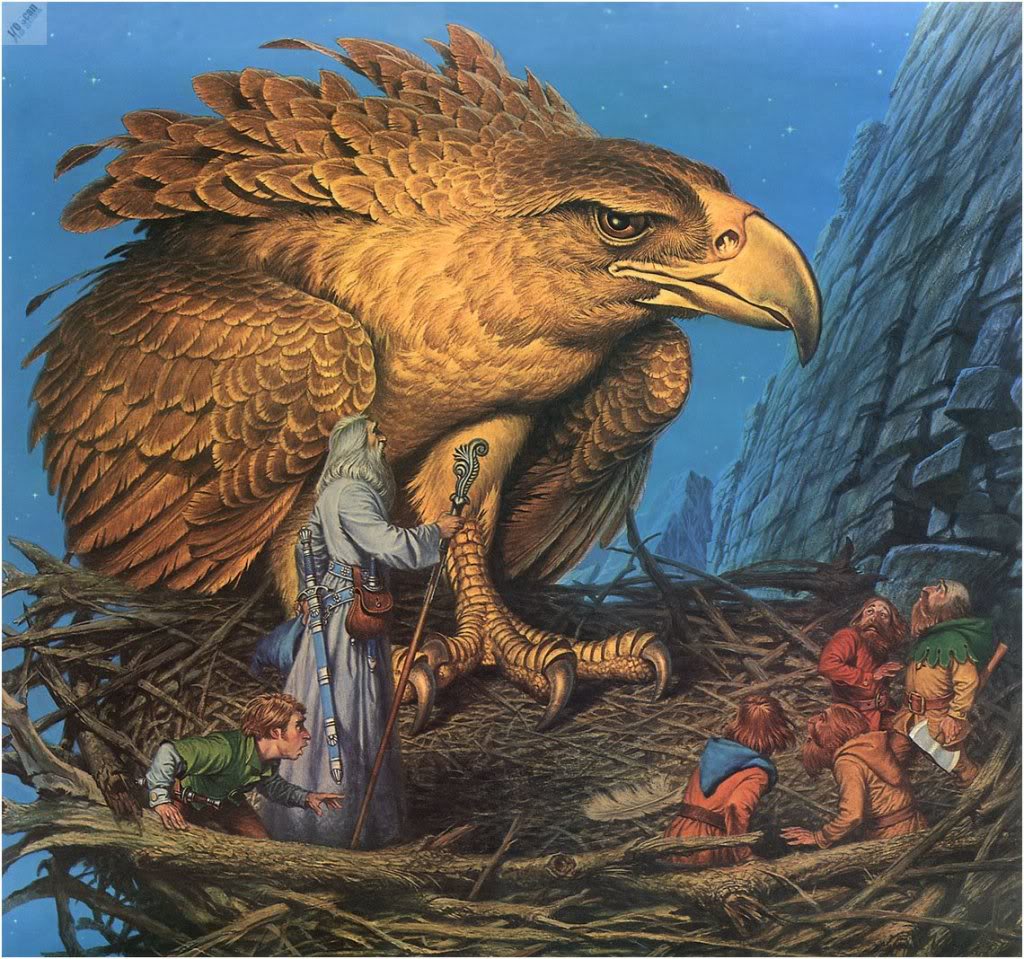
This goddamn badass motherfucking picture, the centerpiece of the crisp golden 1986 Ballantine mass market paperback of The Hobbit, immediately ensnared my fascination and enkindled my love of not only fantasy, but also boss-ass birds big as fuck.

It may come as a surprise to the majority of film critics, then, that I actually enjoyed An Unexpected Journey, despite its several and distinct deviations from the book's original plot. I have my structure issues*, of course I do, but overall, it had thirteen dwarves, three trolls, one ring and a slew of boss-ass birds big as fuck. I was well-satisfied.

What does not well-satisfy me are these assertions, made by many Tolkien diehards and book enthusiasts, that Unexpected Journey is not, in fact, an adaptation of The Hobbit. I take extreme exception to this analysis. Yes, there are several large deviations from the actual text, there's more context given for many of the events that occur and a greater scope is applied with several villains only mentioned in the book's background.

However, with the exception of like, three goddamn scenes you didn't like (Radagast, the White Council and Azog), the movie's about a fucking hobbit who lived in a hole until Gandalf and thirteen dwarves showed up, took him on a quest and then they encountered three trolls, met Elrond in Rivendell, crossed the Misty Mountains, were captured by goblins, the hobbit plays a riddle game, finds a ring, loses his fucking brass buttons, is chased up a tree and carried to safety by eagles. Unless you're a fucking moron, you can clearly see that bears a 90% similarity to the plot of The Hobbit.

Stop saying it's "loosely-based" or "inspired by" or "not my Hobbit". Stop all that pretentious ass bullshit.

Certainly, Unexpected Journey is no Fellowship of the Ring. Certainly not. I do, however, think that the rose-colored glasses of audiences and critics are helping them forget certain other radical changes they'd otherwise have accepted in the Lord of the Rings. Here are a few, in case you forgot:

  • Aniron – Aragorn and Awren's entire relationship plays out off screen, namely in the appendices, not to mention Arwen's substitution for Glorfindel.
  • Gandalf's Battle with the Balrog – woulda been cool to see, but, just like the Nercomancer in the Hobbit, is never depicted in text.
  • Most of Rohan's politics – Eomer's Banishment, Theoden's fleeing to Helm's Deep rather than riding to the ford of Isen, bringing all the goddamn women and children with them, Eowyn even fucking being around then.
  • The Warg Attack En Route to Helm's Deep – Happens in Fellowship to an entirely different group of people and then, it's just wargs, no orcs. Aragorn going AWOL, falling off the cliff and being revived by psychic smooches from Arwen, then, doesn't happen either.
  • Haldir at Helm's Deep – Even showing up, not to mention dying, has no grounds, what so ever, in any continuity. Nor do all Elrond and Galadriel's psychic back and forth.
  • Osgiliath, Anyone? – Literally, unless I'm mistaken, Osgiliath is never depicted first hand once in the books. Lots of people talk about it, several characters go there, but Frodo and Sam are never brought there by Faramir, we never see the successive Fall of Osgiliath when Faramir retreats nor  is such a huge dramatic deal made out of Faramir's doomed attempt to take the city back. Apparently Billy Boyd singing is enough to excuse added material, but Sylvester McCoy riding a rabbit sled isn't?
  • Sam's Abandoning Frodo Before Shelob – Nope. Simple device to make Sam the rescuing hero.
That's just the stuff off the top of my head. That doesn't include the buckets of boring ass shit they cut out – Old Man Willow, Barrow-Wights, Bombadil, Beregond – or things they livened up, like the Last March of the Ents, which is all told by Merry and Pippin after the fact and you never actually see any of.

I guess my point here is that people expect adaptations to be these clean-cut one-to-one transitions from book-to-movie, with no regard to pacing or structure or any discrepancies between mediums. If they can't read the book along the movie and have each beat play out exactly as they want, they'll make wild claims that forswear any connection between the two, over the smallest of added details. No, Unexpected Journey wasn't my ideal interpretation of The Hobbit either, but it was still a more or less faithful adaptation of The Hobbit.

Grow up and thanks for reading.

• The way the opening exposition was divided was very wonky – why would Old Bilbo relate all the history of the dragon, when the dwarf song is included strictly for this purpose? Also, while I don't object to his usage in the new trilogy, there was absolutely no reason to foreshadow the Necromancer this early if he isn't gonna manifest in any real way until the second film. Why waste that time?

Wednesday, July 4, 2012

Brave

As I twarted earlier today, I don't quite understand everybody's kerfuffle with Brave. I thought it was excellent.

Perhaps not exactly up to Pixar's loftiest of standards, maybe, but still, an incredibly solid outing. Great performances, great script, gorgeous fucking visuals (Even I was jealous of Merida's hair) and, overall, extremely entertaining.

Pixar's main problem simply seems to be setting the bar too high. At the point at which near-perfect films like Brave are being called "lackluster" or "boring", I think perhaps audience might have become a little entitled. I'd apologize that Brave doesn't feature cute animals voiced by celebrities but then, I'm not really sorry.

Probably my second favorite Pixar, behind WALL-E.

Also, grotesque undead bears are cooooool. 

Friday, May 11, 2012

Somewhere

Stall: 20 of 75 (26%)

Netflixed Coppola's Golden Lion winner. I've been a big fan of her previous work (specifically Lost In Translation) and I should really see the other two, but I was very impressed with Somewhere.

It's an exceptionally risky script. She's attempting to talk about boredom and the malaise that can occasionally accompany success and, rather than simply depict a character complaining about how bored he is, she takes a gamble and appears to literally attempt to bore the audience with his actions. Whole sequences just depict Dorff not doing anything. Another writer, including me, would have shown a character yearning to do something, or watching people enjoy themselves but, as everyone around him idolizes him, the protagonist can't necessarily complain about his station. It's an amazing risk and overall a great film.

I'm beginning to respect films with less and less dialogue. Drive, as I mentioned previously, does this and Somewhere does it to the extreme. I don't believe, save one scene, the characters of Somewhere discuss the movie's actual theme.

Its ending is perhaps a little dramatic, but even in that, serves as a strong and bold choice made by the director. The more I see of Coppola, the more I like her.

Saturday, April 14, 2012

Conan the Barbarian

Netflixed the most recent E. Howard adaptation, the 2011 Conan starring Jason "Doubledogs" Momoa and directed by Marcus "Stegasaurus" Nispel.

You know, when I slid that movie into my DVD slot, I was fully expecting a festival of over-saturated crap the likes of which no mortal eyes have seen. Boy, was it over-saturated. Boy, was it crap. But, all things considered, I very much enjoyed myself.

The plot is balls. The villains have WAY too much screen-time. Baby Conan has WAY too much screen-time. Anybody who isn't adult Conan or his badass pirate buddy (played by Nonso "Jackhammer" Anozie) has WAY too much screen-time. But, for a decent portion of the movie, Conan drinks, pirates, arm-wrestles, slays and don't take crap off no ass. Sure, there's a pasty revenge "you-burnt-down-my-village" plot sloppily inserted from the Schwarzenegger original. (Canonically, Conan came into your village at night and burnt it down. Canonically, he was your favored enemy.) Momoa, despite being kinda a tool, plays an excellent Conan.

Actually, that probably helps.

If you ratchet your expectations to the floor, can appreciate dumb action flicks and are a fan of the original stories, Conan the Barbarian really isn't an awful outing. A qualified yes.

Friday, March 9, 2012

John Carter (Of Mars)

The missus and I, having just read (or re-read in her case as she's been a Barsoom fan MUCH longer than I) Burrough's Princess of Mars in time for the premiere, caught a matinee of Stanton's John Carter this afternoon.

Overall, as a piece of fanservice, I liked it. It was close enough to Princess (though the major antagonists evidently originate from Gods, which I haven't yet read) for the diehard canonite in me, with lots of loving references, that I can more or less overlook the necessary plot constraints and changes. I attempt to have more of an open mind to book-to-film adaptations and, as long as the spirit is retained, I'm willing to accept and play along with even drastic plot changes (see Two Towers, which was my favorite of book and film trilogy, despite being the most different from its source material.) So, as a fan of Barsoom, I was more or less pleased with the movie and enjoyed seeing several scenes and characters (Woola, especially) visualized*.

As a screenwriter, I was less than impressed. While it had a few well-structured scenes, particularly in the beginning, as the film progressed it fell into several big, unavoidable blockbuster tropes, including shapeshifting villains, an over-convoluted climax and the messy emergence of surprise morals in the protagonist, previously possessed of few. I do honestly think (as he is in the book) John Carter works best as a dumb old boy from Virgina with a mean right hook and not much more to write home about. Making him a bad boy who speaks Apache and has a dark past in which his village was burnt felt unnecessary.

The film also suffered from an attempt to over-compensate the female love interest, Dejah Thoris, from the lilting beauty she is in the novel into a hard-fighting, brilliant scientist bombshell. In all honesty, she made Carter, the ubermench from another planet, look a little underwhelming. Her performance was the most redeeming part of her character but, in general, I think she fell too short.

In summary, if you're a fan of Barsoom, see it. If not, probably a pass.

*Tars Tarkas, my favorite character, was pretty severely emasculated as well, what I consider to be the real crying shame of the picture. The book describes him as literally the greatest Barsoomian warrior living, a seventeen foot tall colossus who easily dispatches all who stand before him, whereas the film has him trounced in practically each action sequence, particularly by Tal Hajus, his ancient rival and (at least in the film) noted glutton and pervert. And finally, when Tarkas' moment for glory comes, Carter unnecessarily fills the roll and slaughters the Jeddak himself, as if bringing down a mated pair of white apes less than sixty seconds ago wasn't enough. Cut a Thark a break, man.

Sunday, February 12, 2012

Drive

Caught Nicolas Winding Refn's latest the other day, after much waiting and hand-wringing. Thought I'd jot down my thoughts, as per local custom.

Drive's script is risky. Reports indicate that Gosling, the star, actually requested his character to have less dialogue than initially appeared in the script and, while this works absolute wonders for the film's pacing, it makes the characterization suffer somewhat. With so little expositional information offered about the protagonist, by the movie's halfway point, where he's revealed to an exceptionally violent character, there's a certain disconnect and I can't, after several days of mulling it over, say that it's necessarily a positive one.

This being said, the movie's pacing is so killer than missed opportunities like this don't occur until hours after watching the film. By drawing dialogue out as drastically as it does, Drive makes every since word count; something difficult to come by in modern scriptwriting. Totally worth viewing and my second favorite script of 2011.* (Plus phenomenal direction and stellar acting too.)

(*For the record, number one is McDonagh's The Guard, two is Drive and three is Farr & Lochhead's Hanna.)

Saturday, January 28, 2012

The Grey

In further celebration of Dan Glaser's birthday, we woke up at the sterling early hour of 11:30 am to attend a screening of Joe Carnahan's The Grey, made famous by the supposition that within, Liam Neeson boxes wolves.

I'll spoil your sport right now. He doesn't.

Yes, this is a film where wolves attack people and yes, I knew this going in, but Carnahan's other work has impressed me before and add Neeson to equation and I'm officially curious. I intended to bite my lip about the zoological inaccuracies and moons did I.

All in all, it's a good film. It's not a terrible film and it's not a great film. Like Tintin and Young Adult, I'm loathe to admit that the script itself is the weak link. It's Neeson's best performance to date (that I've seen), Carnahan's direction is solid and most of the supporting cast give convincing portrayals but, as I complain about everything these days, the structure really left something to be desired. An uninteresting prologue to establish the main character, an uneven juggling of wolves and the elements as joint antagonists and "survival story" trope characters.

That being said, the animal nut in me was continually cringing from the mishandling of the wolves. Rather than using the pack as an appropriate analogy for the group of stranded men, they're simply pseudo-supernatural monsters, attacking in pairs or alone and rarely behaving or acting like the animals they're meant to be. I won't rant overmuch, but what really stuck in my craw about the script was it's tendency to dispense wolf facts left and right and blatantly ignore how inaccurate their entire premise appeared to be. A simple handwave about "being close to the den" and suddenly the wolves are malicious killers, rather than territorial animals or opportunistic scavengers.

I think maybe a mean old Kodiak would have served their purposes better.

Wednesday, January 25, 2012

The Adventures of Tintin: The Secret of the Unicorn

In lieu of frighteningly vivid lazer tagg, both because it costs $15 a fucking person and because something like this would probably happen, Dan Glaser, Steven Molony and I attended a moving picture film at our local cinema out here in historic Rancho Cucamonga. We attended a 3D showing of The Adventures of Tintin: The Secret of the Unicorn (mostly for The Hobbit trailer) and overall, enjoyed ourselves. More detailed thoughts on the script follow.

While I found the movie to be rollicking, swashbuckling adventure of a high caliber, I'm loathe to admit it had almost nothing to do with the script itself. The action scenes were creative, elaborate and pleasingly pulpy but, even with big-hitters Moffat, Wright and Cornish, I can't shake the feeling that's more to do with Spielberg and Jackson than any officially credited screenwriter. I'd be the first to admit that, in the case of most pictures, the action of the story is as much a part of a screenplay as the dialogue itself, but with two auteurs of that caliber behind the wheel, I feel like Tintin could be the exception.

I found the characterization somewhat lacking, the pacing too breakneck and the dialogue frankly unimpressive; how much of that is an attempt to capture the creator's original work, I don't know, but the film is definitely more engaging on a technical and performance level. (Which, by the way, are insane. Certainly it cost, what, 135 million to achieve, but the mo cap is truly something to see.) A beautiful, remarkable and extremely well-made film, if perhaps somewhat uneven. Definitely worth the watch.

Wednesday, January 4, 2012

Young Adult


I don't particularly value film critics and I especially don't value film criticism. Having actual skin the game, I feel they don't benefit me personally, so I don't hold any illusions they benefit any other filmmakers. I'm not, therefore, going to offer ratings, anything beyond "see it" or "don't see it" but I caught a showing of Reitman's newest this evening and had thoughts.

Diablo Cody's third outing, (her second for me, since I haven't seen Jennifer's Body) and I was honestly underwhelmed. I'm probably more interested in character study than the next person, but I found myself bored a fair majority of the film – it had an extremely difficult time keeping my interest. To me, themes they were attempting to establish as central to the film's core didn't really appear until mid-way through the experience, when I'd more or less made my assumptions and judgments about the main players and their interactions. Rather than these ideas coming meaningfully to life, it felt as though a separate script was attempting to exert itself over the second half of the film. Beyond that, I couldn't shake the uncomfortable twinge of auto-biography, something confirmed by Cody herself. (I'm rarely a fan of such blatant parallelism.) I wouldn't call Young Adult a bad film; performances are solid (though I imagine a more nuanced actress like Louise-Parker could have handled the material better), direction was surprisingly straightforward and effective, but the screenplay, in the end, fell short. Worth watching.

I will say, as a final caveat, that my writing standards are unfairly high. I attempt to push myself to write things outside of my comfort zone and into new genres, so if anyone disagrees with me about anything writing-related, they're probably not wrong; I'm just opinionated.